OSHA Porta Potty Requirements for Ohio Construction Sites
OSHA porta potty requirements for Ohio construction sites come from one federal table, and the math is simpler than most people expect.
A real person answers live Mon–Sat 7:00 am – 7:00 pm. Quotes back in under 1 business hour.
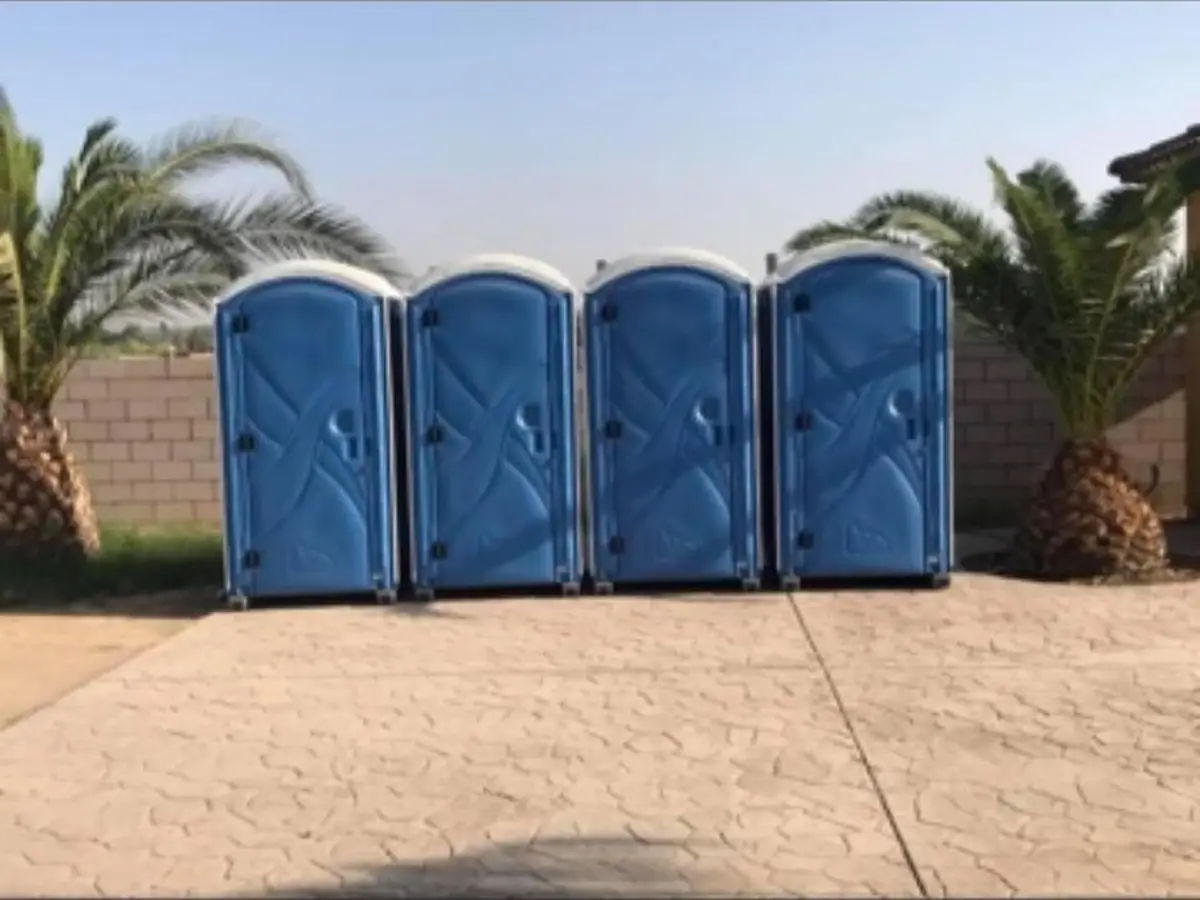
- Key point
- Jobsites with 20 or fewer workers need at least 1 toilet under OSHA rule 1926.51, Table D-1.
- Key point
- Over 20 workers, OSHA requires 1 toilet seat and 1 urinal per 40 workers on the site.
- Key point
- At 200 or more workers, the ratio changes to 1 seat and 1 urinal for every 50 workers on site.
- Key point
- The legal minimum is only a floor. We suggest 1 unit per 10 workers on 40-hour weeks with weekly service.
- Key point
- Federal OSHA covers private Ohio employers, because Ohio has no OSHA state plan for private-sector jobs.
What are the OSHA porta potty requirements for a construction site?
Quick answerOSHA rule 29 CFR 1926.51(c) requires toilets on every construction site based on crew size. Table D-1 sets the count: 20 or fewer workers need at least 1 toilet. Above 20, the site needs 1 toilet seat and 1 urinal per 40 workers. At 200 or more workers, the ratio becomes 1 seat and 1 urinal per 50.
| Number of employees | Minimum facilities (Table D-1) |
|---|---|
| 20 or less | 1 toilet |
| 20 or more | 1 toilet seat and 1 urinal per 40 workers |
| 200 or more | 1 toilet seat and 1 urinal per 50 workers |
You can read the full rule on the OSHA 1926.51 sanitation standard page. The same rule says that under temporary field conditions, at least 1 toilet facility must be available. A chemical toilet, which is what a porta potty is, counts when the site has no sewer hookup.
Count every worker on site, subs included. When the count lands on a fraction, round up.
What does "readily available" mean for jobsite toilets?
Quick answerReadily available means a worker can reach a toilet without long delays or a long trip. OSHA has said in its guidance that workers must be able to use a toilet when they need to. A unit locked up, buried in snow, or 10 minutes away across a big site does not meet the spirit of the rule.
Table D-1 counts units. Readily available is about where those units sit and whether people can actually use them. Here is how we apply that on real sites:
- Spread units out on big sites. On a long road job or a wide subdivision, place units near each work area, not all at the trailer.
- Keep the path clear. In winter, shovel a 4-ft path to the door. A unit behind a snowbank is not available.
- Keep it serviced. A full tank or no paper means people stop using it. Weekly service keeps the unit usable.
Are mobile crews exempt from the OSHA toilet rule?
Quick answerMobile crews are exempt from 1926.51(c) when they have transportation readily available to nearby toilet facilities. A paving crew moving down a road with a truck can drive to a gas station or shop restroom. The exemption ends when the crew parks on one site for days, or when no toilet is nearby.
The exemption is in paragraph (c)(4) of the rule. It fits crews that move through the day, like utility locators, line-painting crews, or a roofer doing two small jobs in one afternoon.
The exemption does not fit a crew parked on one lot for a week. If the nearest restroom is a long drive, plan on a unit.
Does OSHA require handwashing stations on construction sites?
Quick answerOSHA rule 1926.51(f) requires washing facilities when workers handle paints, coatings, herbicides, insecticides, or other harmful contaminants. The station must be near the work and let workers remove the substance. Many contractors add a hand-wash station on every site anyway, since sanitizer does not remove grease, concrete dust, or lead paint residue.
A two-sided hand-washing station holds about 20 gallons of fresh water and gives roughly 200–250 washes. It uses foot pumps, so it needs no hose or power. A hand-washing station rental runs from $90 per 28-day cycle on a monthly job, with weekly refills included.
In winter, water stations can freeze. When lows stay below 28°F, we can swap to a sanitizer dispenser on request, but check with your safety lead first on lead or coating jobs.
What are the OSHA field sanitation rules for Ohio farms?
Quick answerOSHA rule 29 CFR 1928.110 covers farms with 11 or more workers doing hand labor in the field. The farm must provide 1 toilet and 1 handwashing facility per 20 workers, within a quarter-mile walk. Crews working 3 hours or less in the field that day, including travel time, are not covered by the rule.
The full text is on the OSHA 1928.110 field sanitation page. If the terrain makes a quarter-mile walk impossible, the units go at the nearest point a vehicle can reach.
For Northeast Ohio farms, that usually means picking seasons, nursery work, and vegetable harvest in Lorain, Medina and Geauga counties. Our truck needs to get within about 25 ft on firm ground, so pick a spot on a farm lane or gravel pad.
Does Ohio have its own OSHA rules for private jobsites?
Quick answerOhio has no OSHA-approved state plan for private employers, so federal OSHA rules apply on private Ohio jobsites. That means Table D-1 and rule 1926.51 are the numbers that count. Public employees in Ohio, like city and county workers, fall under a separate state program called PERRP, run through the Ohio Bureau of Workers' Compensation.
You can check which states run their own plans on the OSHA state plans page. For a private builder in Cleveland, Akron or anywhere in Northeast Ohio, the federal rule is the one to follow.
Legal minimum vs. what actually works: how many porta potties per worker?
The OSHA minimum for 20 workers is 1 toilet, but 1 unit for 20 people fills well before a weekly service. A standard unit holds roughly 200 uses between services. We recommend 1 standard unit per 10 workers on a 40-hour week with weekly service, then add units or a second weekly service as the crew grows.
Here is the math. Ten workers each using the unit 3–4 times a day over 5 days comes to 150–200 uses. That lands right at the tank limit of a standard unit by service day. Twenty workers on 1 unit would double that and overflow by midweek.
The legal number satisfies an inspector. The recommended number keeps the crew on site. For the full sizing method for events and jobs side by side, see our guide on how many porta potties you need.
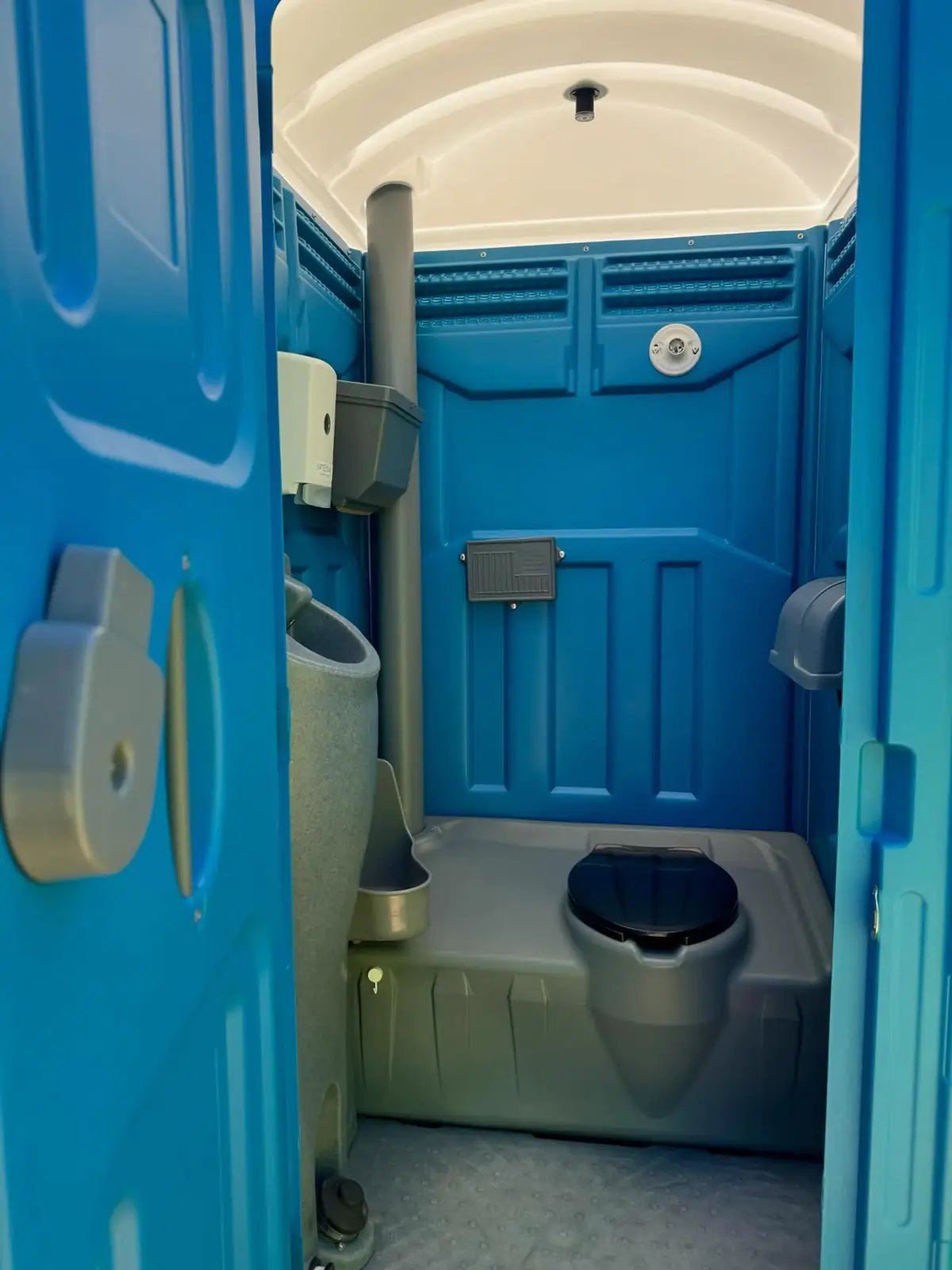
Worked examples: OSHA minimum vs. our recommendation for 8, 25, 60 and 220 workers
Quick answerThese four examples show the Table D-1 legal minimum next to our recommended count for a 40-hour week with weekly service. The gap grows with crew size. At 220 workers, OSHA requires 5 seats and 5 urinals, while a comfortable setup is closer to 22 standard units or fewer units with extra service visits.
| Workers on site | OSHA minimum (Table D-1) | Our recommendation | Monthly units cost from (before tax) |
|---|---|---|---|
| 8 | 1 toilet | 1 standard unit, weekly service | $145 |
| 25 | 1 seat + 1 urinal (25 ÷ 40, rounded up) | 3 standard units, weekly service | $435 |
| 60 | 2 seats + 2 urinals (60 ÷ 40 = 1.5, rounded up) | 6 standard units, weekly service | $870 |
| 220 | 5 seats + 5 urinals (220 ÷ 50 = 4.4, rounded up) | 22 standard units, or fewer units with twice-weekly service | $3,190 for 22 units |
Each standard unit has a seat and a urinal in one stall. Prices are starting rates per 28-day cycle with weekly service included, before Ohio sales tax. Add a hand-wash station from $90 per cycle where crews handle paint, coatings or chemicals.
On big sites, twice-weekly service can cut the unit count. Each extra service visit is $55.
What is the next step after you know your count?
Quick answerThe next step is to match your crew count to a unit plan and a service day. Tell us the number of workers, the hours, and the site address. We send an itemized quote with units, delivery, pickup, weekly service and tax. Orders confirmed by noon Monday through Saturday can be delivered the same day.
Our construction porta potty rental page covers 28-day billing, net-15 accounts for approved contractors, and how pickup works. There is no long-term contract. Text or call 2 business days before you want the units picked up, and billing stops on that date.
For a crew staying more than a few months, see our long-term porta potty rental details. Need a unit on site today? Our same-day porta potty rental option costs $75 when you confirm by 12:00 noon.
Common questions
How many porta potties does OSHA require for 20 workers?
OSHA Table D-1 requires 1 toilet for 20 or fewer workers. That is the legal floor. In practice, 1 unit for 20 people fills well before weekly service. We suggest 2 standard units for a 20-person crew on a 40-hour week, which runs from $290 per 28-day cycle before tax with weekly service included.
Does a porta potty with a urinal count as both a seat and a urinal under OSHA?
A standard porta potty has both a toilet seat and a wall urinal in one stall. Many contractors count it toward both columns of Table D-1. The catch is that only 1 person can use it at a time. On bigger crews, add units based on actual use, not only the paper count.
Can my crew just use the restroom inside the house we are remodeling?
A working restroom in the building can count as a toilet facility if the homeowner or building manager allows it and it stays usable. Many homeowners say no once work starts, and the water may be shut off during plumbing work. A standard unit in the driveway avoids that problem and runs from $145 per 28 days with weekly service.
Do OSHA rules require a separate porta potty for women on a jobsite?
OSHA's general industry rule calls for separate toilet rooms by sex unless each room is single-occupant and locks from inside. The construction table does not spell that out. A porta potty is a single-occupant stall with an inside latch, so each unit works for anyone. Many mixed crews still label 1 unit for women.
How often does OSHA say a jobsite porta potty must be cleaned?
OSHA rule 1926.51 requires toilets to be kept sanitary, but it does not list a fixed service day. Weekly pumping and cleaning is the industry norm for a 40-hour crew of about 10. Our construction rentals include weekly service, and an extra visit costs $55 when a busy week fills the tank early.
Who checks porta potty counts on an Ohio jobsite?
Federal OSHA inspectors enforce Table D-1 on private Ohio jobsites, since Ohio has no state plan for private employers. Your general contractor and the client paying for the project may also check counts under the contract. Public employers in Ohio fall under the state PERRP program instead of federal OSHA.
Get a jobsite toilet count and quote for your crew size
Send your ZIP, dates and unit type, or call for the fastest answer. Same-day cutoff is noon.
(216) 223-2644Tap to call. Live answer Mon–Sat 7:00 am – 7:00 pm. Same-day cutoff is 12:00 noon.